Two books
Posted on May 28, 2013
I have a tendency of reading more than one book at a time. Right now, Chang-Rae Lee’s A Gesture Life is sitting on my nightstand. It’s what I’m reading at home. Judy Fong Bates’ Midnight at the Dragon Café is in my bag. It gets read everywhere else, especially in my car as I wait for my daughter during her piano lessons and band practice.
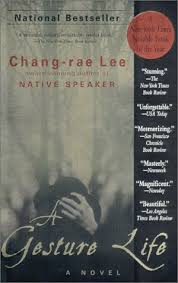
A Gesture Life by Chang-Rae Lee
Lee, a Korean-American writer, immigrated to the States in 1965. A Gesture Life weaves some heavy issues into the storytelling, including the treatment of Korean comfort women by the Japanese Imperial Army during World War II – something the protagonist witnessed during his years of military service. Needless to say, it has a profound effect on him that lasts a lifetime.
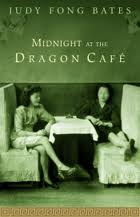
Midnight at the Dragon Cafe by Judy Fong Bates
Fong-Bates is a Chinese-Canadian writer. I’m only a couple of chapters into Midnight at the Dragon Café, which was recommended to me by a friend. The book was the 2011 One Book Community Read for the city of Toronto.
The boy ate an apple
Posted on May 26, 2013
 One of my goals this year was to read books by writers of Asian heritage, or to read more stories with protagonists of diverse backgrounds. I regret that growing up and all through these years, I haven’t made it a priority to expose myself to stories told in multicultural voices.
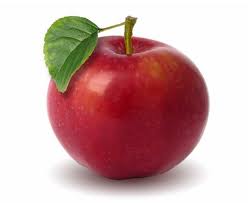
Through high school, university, and college curriculums, I have been exposed to a wealth of brilliant writers, from Chaucer to Hemingway, and many Canadian writers in between. I didn’t even stop to consider that all the stories I read were told from a Western perspective. This has had an interesting impact on me as a reader and now as a writer. I assume every character I read about is white unless told otherwise. I’m not alone. When I wrote ‘The boy ate an apple’ on the chalkboard and asked a classroom full of students, “What ethnicity was that boy?” All of them, even the black and Asian students responded, “white”.
As Canadian educators, writers, and readers, we need to do a better job of promoting diverse voices and experiences. It is 2013, yet the reading lists for Independent Study Projects in senior English classes haven’t changed much since the 80s when I was in high school. To throw in the odd book by a black or Asian writer to “modernize and update” the list isn’t enough.
Recommended Read:
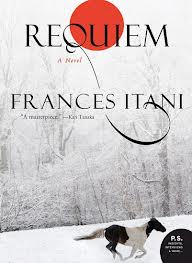
Requiem by Frances Itani
I recently finished Frances Itani’s Requiem, a story about Bin, a Japanese Canadian struggling with loss on many levels. Although set in 1997, the story takes readers back to 1942, a year after the attack on Pearl Harbor. Twenty-two thousand Japanese Canadians in British Columbia were interned, in what is one of Canada’s darkest periods in history.
April Poems
Posted on April 4, 2013
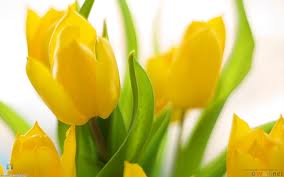
April flowers bring…
Emily Dickinson said, “If I feel physically as if the top of my head were taken off, I know that is poetry.”
Organized and sponsored by the League of Canadian Poets, Canada has acknowledged April as National Poetry Month since 1999. The United States introduced the idea in 1996. Great Britain celebrates October as their National Poetry Month.
Sometimes I struggle through a poem, lost in the words or its meaning. I love the freedom that comes with reading them. There are no right or wrong answers – there shouldn’t be. You can read a poem, and it is yours to interpret; yours to personalize. I love how some poems make me feel. Like music, they can provoke me to tears, to laughter. Or they can leave me thinking, reflecting. Sometimes, they even leave me confused and dazed.
A few of my favourites:
The Cross of Snow by Henry Wadsworth Longfellow
A haunting poem. Longfellow’s wife burned so badly when her dress caught on fire, she died shortly afterwards.
i carry your heart with me by e.e. cummings
One of the best love poems ever.
I Am in Need of Music by Elizabeth Bishop
A classic.
And in honour of both National Poetry Month and the month of April:
Always Marry An April Girl by Ogden Nash
My favourite Canadian poets include: Leonard Cohen, Michael Ondaatje, Margaret Atwood and Catherine Graham.
More on National Poetry Month:
St. Paul’s Square or St. Pauls Square?
Posted on April 3, 2013
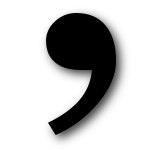 Wow – there really is an organization called the Apostrophe Protection Society. It exists in England and thanks to its founder, John Richards, the apostrophe that had been banned from local street signs in Mid Devon, England, has been lifted.
Apparently the apostrophe debate has been ongoing for years there (see here). Town Council had argued in favour of removing the apostrophe. They stated that they were receiving too many complaints from the public about the proper use of apostrophes, and that the apostrophes were confusing the GPS systems.
As a former ESL student and ESL teacher, I could only imagine the confusion the absence of an apostrophe could create for students learning English. St. Pauls Square – does it belong to Paul? Or are there many Pauls?
Grammarians rejoice as English town drops apostrophe ban
Eats, Shoots & Leaves: The Zero Tolerance Approach to Punctuation by Lynn Truss (paperback)
Life lessons
Posted on March 19, 2013

Autumn Birds by Ko Kil-Ja
My mother, Ko Kil-Ja, discovered her talent and passion for Korean brush painting when she took up the art while recovering from breast cancer. Today, she is a prolific artist who has had her work showcased in several exhibitions. In honour of her 70th birthday, I decided to post some important life lessons that I learned from her.
1. The world owes us nothing.
The reality that is my mother’s life – war, immigration, illnesses – suggests that the world can be a battlefield of obstacles and challenges. Conflicts can come at all levels: societal to personal, and everything in between. Watching my mother navigate through hardships has taught me the importance of being independent and self-reliant, especially as a woman. This is one of the most crucial lessons that I feel all women must learn if they are to achieve true self- fulfillment.
2. We must give and give freely.
Whether it is through her charity work, her art or her teaching, my mother’s commitment to the world around her shows her belief that we should live life for a purpose greater than ourselves. Throughout history, all the great people have embraced this way of thinking and lived for a strong purpose. More than just a responsibility or obligation, this belief allows us to develop a sense of connectedness with others and opens our hearts and our minds.
3. Our passion can become our sunlight.
Finding her passion for meditation and painting, I believe, has changed my mother’s life. It has allowed her to embrace life fully and become the person she was meant to be. There is purpose and fulfillment in each day. There is beauty.
The wonderful thing about pursuing passions such as painting and writing is that they allow us to keep learning and growing as we move toward mastery. We can not only enjoy the sunshine but can bask in its warmth and glow.
Year of the Snake
Posted on February 10, 2013
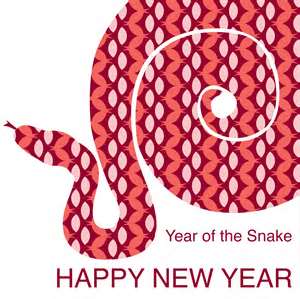
Sunday, February 10, 2013
Happy Lunar New Year, and
welcome the Year of The Snake.
Just for fun:
- Year of the Snake: The Serpent Behind the Horoscope: Five Parallels Between the Zodiac Sign and the Real Deal (National Geographic article)
Happy, dark, or ironic – Short stories with a twist
Posted on January 31, 2013
 Whether they are happy, dark, or ironic, I love twist endings. I stumbled onto “A Letter to God”, a short story by Gregorio Lopez Fuentes (translated by Donald A. Yates). It is about a poor farmer named Lencho who sadly loses his crops during a terrible hailstorm. Poor, but a man with strong faith, he writes to God and asks for money to help him get through the winter. The ending made me laugh out loud – it was so nutty. You can click on the story title to read it online.
Some of my other favourite short stories with a twist include “The Necklace” by Guy de Maupassant and “The Story of an Hour” by Kate Chopin.
It takes talent and good storytelling to create a twist ending that works. It can’t feel forced or heavy-handed to be effective.
Here are some links you might want to check out:
My first e-reader (sigh)
Posted on January 28, 2013
 When I was asked if I wanted an e-reader for Christmas, my answer was a flat out, “no”. I love the texture of paper pages, the smell of new books and the worn-out feel of second-hand books. I also love walking into bookstores and being surrounded by books of all sizes, shapes, and colours.
But when the second book that I really wanted to read was only available in e-book format, I thought maybe it was time to at least be open to the possibility of an e-reader.
As soon as I walked into my local Chapters bookstore, I was greeted by a friendly Kobo salesperson who happily walked me through his display.
“This is the one I own,” he said, and passed me a Kobo Glo.
It didn’t feel so bad in my hands, especially when it was put into a case that looked like a book cover.
I wasn’t entirely sure if it was a good or bad thing that the reader could customize the font size, justification, margins, and even the line spacing. I knew editors who laboured and agonized over such decisions. The fact that any reader could now arbitrarily change everything seemed somehow wrong.
I love the built-in dictionary though. By pressing any word, I instantly get its meaning. As well, the ability to highlight passages and make notes about them is very cool.
The Kobo Glo also has a built-in light which I’m thinking will be great for reading in my car when I’m waiting for my daughter in the parking lot of her music school.
Still not sure where I stand in the e-book vs traditional book debate. Will find out soon though. I’ve downloaded a few books including The Ginger Man by J.P. Donleavy which was recommended to me by Donleavy’s grandnephew, and hard to find in print version in Toronto.
Memorable characters 2
Posted on January 21, 2013
 I love books where I feel connected with the main character, or when the character is someone whom I admire and want to root for. I recently saw Les Miserables again. Jean Valjean is an example of a character I both admire and feel tremendous sympathy for – a character almost impossible for me to forget.
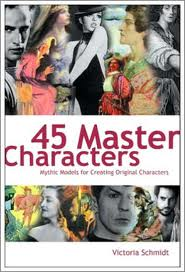
There are several books and online resources that offer great advice, tips, and suggestions on how to create complex and compelling characters. One book title I’d like to pass along is Victoria Lynn Schmidt’s 45 Master Characters: Mythic Models for Creating Original Characters. It’s definitely worth checking out. Schmidt looks at several archetypes, both heroic and villainous, to explore character traits and behaviours. Her examples of memorable characters from books, movies, and T.V. are especially helpful in shaping our understanding of classic archetypes.
Also worth checking out:
- How to Craft Compelling Characters – Writer’s Digest
Great article; a must read if only to review what you already knew - Character Creation – Fiction Factor
Links to online articles about everything you need to know about creating characters in fiction
Memorable characters
Posted on January 14, 2013
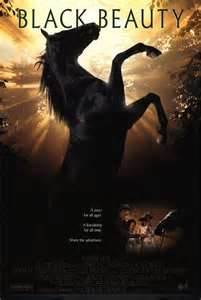
Black Beauty by Anna Sewell (1877)
“It’s told from the point of view of a horse,” my daughter, Claire, told me when she started reading Black Beauty. “I don’t know if I want to read it.” She finished the book today, and concluded that it was a great read, and Black Beauty was a character she wouldn’t ever forget.
When Claire asked me to name some memorable characters from books I had read, the first few names that came to mind were:
Nomi Nickel, A Complicated Kindness by Miriam Toews (Canadian)
Sixteen-year old Nomi, who lives in a Mennonite community, is abandoned by both her mother and sister. She asks a question that continues to haunt me: “Is it wrong to trust in a beautiful lie if it helps you get through life?”
Atticus Finch, To Kill A Mockingbird by Harper Lee
As a kid, I had a crush on Atticus, and wondered how many fathers were like him in real life. He was so wise and had the right things to say about everything that mattered: “You never really know a man till you walk a mile in his shoes.”
Dunstan Ramsay, Fifth Business by Robertson Davies (Canadian)
I read this book in grade 12 English class. Dunstan’s involvement with Mary Dempster, a woman he spends his life trying to make a “saint,” is a result of his deep rooted childhood guilt: “I feared to go to sleep and prayed till I sweated that God would forgive me for my mountainous crime… I was alone with my guilt, and it tortured me.”
Anne Shirley, Anne of Green Gables by L.L. Montgomery (Canadian)
I remember wondering if I should add an “e” to the end of my name after reading Anne say, “A-n-n looks dreadful, but A-n-n-e looks so much more distinguished.”
Iago, Othello by William Shakespeare
I’m wowed by his evil brilliance as much as I fear it. I still get chills reading, “I am not who I am.”
 ann y.k. choi